The short answer
What this page is, and is not
Why the standard ends up in your contract
Electricity distribution businesses run continuous, regulated vegetation programs to maintain clearances and reduce bushfire ignition risk. Those programs are audited, contracted and renewed on multi-year cycles, and the network operator carries the regulatory obligation. Specifying AS 4373 is how that obligation is pushed down into the contract you are signing.
Councils and road authorities do the same for sight lines, clearance envelopes, footpath access and fire trail maintenance. The work is scheduled, budgeted and tendered, and the specification is the mechanism by which a purchaser buys a consistent result from several different contractors.
For a contractor, that is the whole commercial argument for the category. Compliance-specified work is recurring by design, and it rewards mechanisation precisely because the purchaser needs a repeatable outcome across a large program.
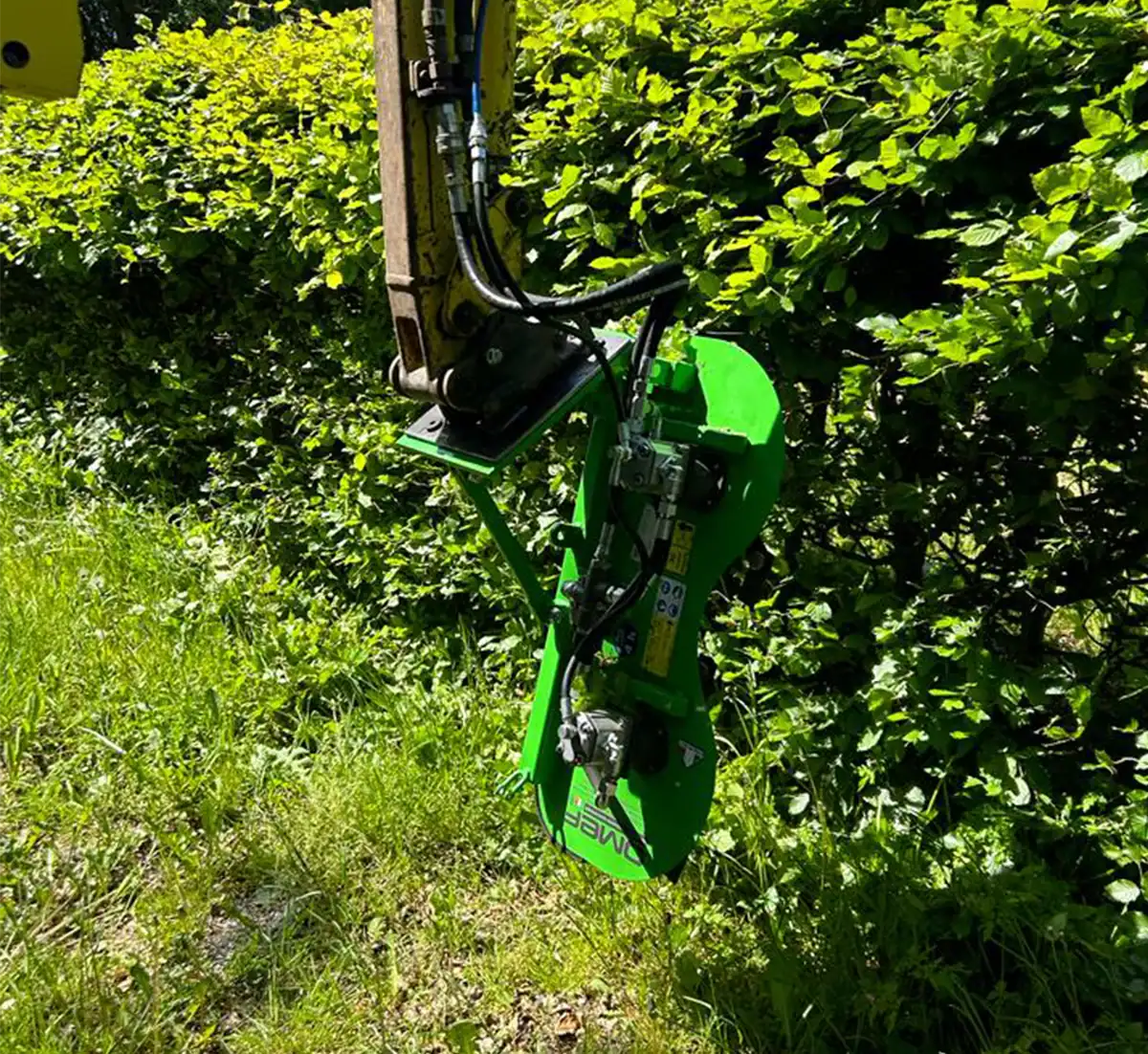
The standard governs the cut, not the method
A pruning specification describes the result required on the tree. It does not, in itself, prohibit mechanisation. What it does is constrain which tools are acceptable, because trimming to AS 4373 can require branches be cut back to growth points. That is a technical specification, not a preference, and a tool that cannot reliably produce that result is not suitable for that contract no matter how productive it is.
The corollary matters just as much: no attachment is “AS 4373 certified”. Compliance is your responsibility, not the tool’s. A machine can produce a non-compliant cut, and the fact that it was sold for pruning work is not a defence at inspection.
What this means for tool choice
| System | How it cuts | Compliance consideration |
|---|---|---|
| Star-knife hedge trimmer | Rapidly rotating star-shaped knives shred material for a clean, even face with minimal residue | Suited to hedge and mass-vegetation faces. Check whether the contract wants a shredded face or discrete branch cuts. |
| Comb-blade shearing bar | Comb-shaped blades cut in a shearing motion | Produces a discrete cut rather than a shredded face, which suits specifications written around branch cuts. |
| Rotating disc trimmer | Disc-mounted blades at speed | Fast on volume. Finish is coarser, so confirm it against what the specification will accept. |
| Forestry pruner | Cutting bar at the limb | Best control over an individual cut, which is what a growth-point specification generally implies. |
Capacity limits are firm, not indicative
Where mechanised pruning is not appropriate
- 01
Heritage and significant trees
Generally require hand pruning. Tendering mechanised pruning for work that specifies otherwise is a fast way to lose the contract and the relationship. - 02
Specimen plantings
Where the individual form of the tree is the point, a mechanised finish will not satisfy the purchaser even if it satisfies a clearance. - 03
Oversize material
Beyond the head's rated capacity the cut degrades and the tool suffers. Plan a hand or saw component into the methodology rather than pushing the machine.
Demonstrating compliance in a tender
- 01
State the specification you are working to
Name it, and name the version the contract references. A methodology that says \u201cindustry best practice\u201d where the contract says AS 4373 is already behind. - 02
Justify the plant selection
Say which head you will use and why the finish it produces satisfies the specification. This is the step that separates a deliberate choice from whatever was on the truck. - 03
State your capacity limits
Give the rated cutting capacity of the head and explain how material above it will be handled. Purchasers read this as competence rather than as a limitation. - 04
Cover operator competency and safety
Operator training, plus the guarding and coupling standards relevant to working at height beside a road: ISO 8084 for operator protective structures, AS 4772 or ISO 13031 for quick hitches.
Red flags when equipping for compliance-specified work
A supplier claiming an attachment is “AS 4373 certified”
The standard governs the work, not the machine. There is no such certification, and a supplier offering it either misunderstands the standard or is hoping you do.
Choosing a head on productivity alone
Throughput is worthless if the finish fails inspection. Match the system to the specified result first, then compare productivity among the heads that qualify.
No stated cutting capacity
Capacity limits are firm. A quote without a rated diameter gives you nothing to write into a methodology and nothing to hold the supplier to.
Assuming one circuit suits the category
Hydraulic requirements vary sharply between pruning tools — some need a drainage line, some do not, and some need two double-acting lines. Check before assuming the tool will fit your machine.
Before you tender mechanised pruning
Compliance readiness checklist
- The specification named in the contract, and its version
- A copy of the standard, obtained from Standards Australia
- Head type matched to the specified finish
- Rated cutting capacity of the head, in writing
- Method for handling oversize material
- Scope exclusions for heritage and significant trees
- Operator training and competency records
- Quick hitch compliance with AS 4772 or ISO 13031
- Operator protective structure per ISO 8084 where relevant
- Blade and knife availability in Australia
- Traffic management for roadside works
- Rectification process if a cut is queried