The short answer
Why this outranks purchase price
An attachment is bought once and consumed continuously. At low utilisation the purchase price dominates, which is why an occasional-use tool can be bought on invoice price without much harm. Past a few hundred hours a year that reverses: the sum of every tooth, chain and blade you fit over the life of the tool comfortably exceeds what you paid for it, and it is the number that decides whether your quoted rate holds.
The mulcher case states it most plainly. A mulcher is not bought on cutting capacity. It is bought on hectares per day at an acceptable tooth cost, and two machines with identical brochures can produce completely different economics depending on rotor choice and the ground you put them in.
Track it per site type, not as an average
What wears, by category
| Category | Main consumable | Replacement rhythm | What drives the rate |
|---|---|---|---|
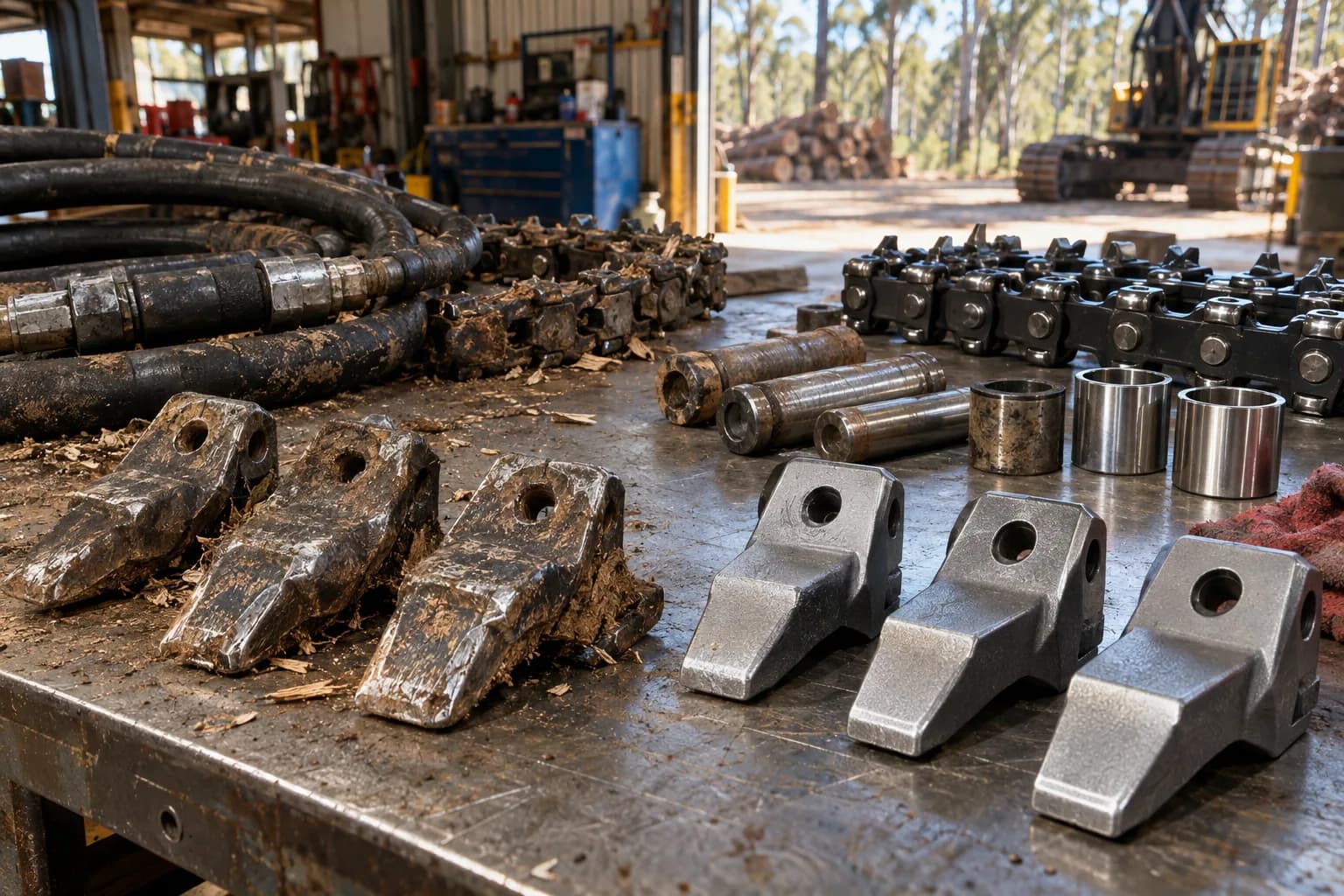
| Forestry mulchers | Rotor teeth, hammers or knives | Monthly budget line in abrasive ground; a rounding error in clean ground | Ground contact, stone, ironstone, buried debris. Rotor choice matters more than model choice. |
| Stump grinders | Cutting teeth | Monthly in abrasive ground | Soil, almost entirely — not wood. Sandy and rocky ground eat teeth; clean clay is gentle. |
| Grapple saws | Harvester chain and bar | Weekly conversation | Dirty timber, ground contact, incorrect tensioning. Auto lubrication reduces wear, it does not remove it. |
| Tree shears | Blade, plus pins and bushes | Periodic rebuild | Hardwood, buttressed stems, oversize diameter. Ignored pin wear lets the jaw track out and destroys blades. |
| Stump cutters | Jaw and blade wear surfaces | Periodic rebuild | Soil, grit and rock lodged in the root plate. Hardox slows it down; it does not stop it. |
| Log and forestry grabs | Tine tips, rotator service | Low, unless the grab is used to rake | Ground contact and side loading. Raking with a grab is faster than operators think and dearer than they think. |
| Mechanical pruning | Blades and knives | Varies sharply by system | Dirty bark, wire, dead hardwood. Star knives, comb blades and discs wear differently and cost differently. |
| Tillage and ground prep | Auger teeth and pilot bits | Ground-dependent | Rock and gravel are brutal. Replaceable wear parts are the design answer, so confirm stock before relying on it. |
Teeth: the ground decides, not the timber
Buyers reliably assume that hard timber wears teeth and soft timber does not. On a stump grinder that is close to backwards. Rate of wear is driven almost entirely by soil. Sandy and rocky ground eat teeth. Clean clay is gentle. Decomposed granite, or fill full of builder’s rubble, is in a category of its own and should be priced that way before you quote the job rather than after.
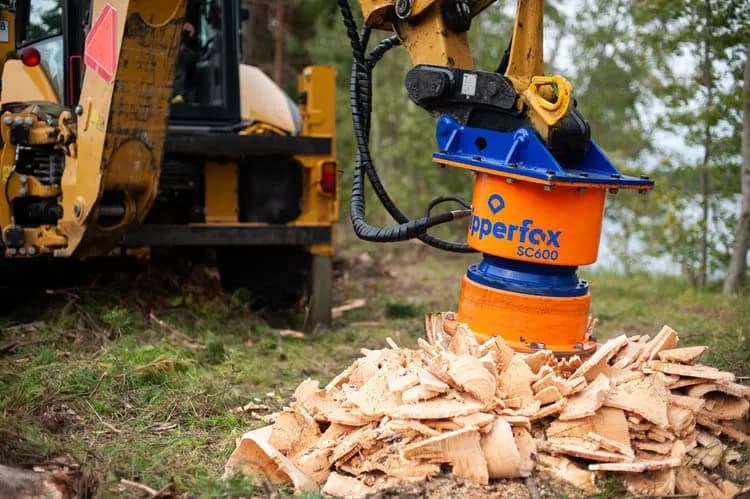
Mulchers follow the same logic the moment the rotor touches ground, which on most clearing work is constantly. This is why rotor choice is the real decision rather than the model number. Fixed teeth cut faster and finer in clean conditions and produce better mulch quality, but they are less tolerant of impact. Hammers and knives behave differently again.
The rule that follows is simple and routinely ignored: pick the rotor for the worst ground you will work in regularly, not the best. A fixed-tooth rotor on a site full of ironstone is a very expensive lesson.
Chain and bar: not chainsaw chain
Forestry grapple saws run harvester chain, typically in 0.404″ or 3/4″ pitch. It is not hardware-store chainsaw chain, pricing reflects that, and substituting is a safety question rather than a procurement one. Pitch also determines which chain and bar will fit, so confirm it before ordering — and be wary of any specification quoting a pitch that is not a standard size.
Automatic chain tensioning and lubrication, fitted on the Powerhand units, meaningfully extend chain and bar life. They reduce wear; they do not remove it. Budget chain weekly on a saw that is working, and treat a supplier who cannot quote chain and bar pricing from stock as a supply risk rather than a price difference.
How to build a wear-parts budget
- 01
Get pricing in writing before purchase
A supplier who will not quote wear parts before the sale is unlikely to be sharper about them afterwards. Ask for a full set price, not a per-item price, because a full set is what you actually buy. - 02
Ask for hours, not just price
The useful question is how many hours a set lasts in ground like yours. A cheaper set that lasts half as long is more expensive, and the only way to see that is to divide by hours. - 03
Separate your site types
Clean ground and stony ground are not the same job and should not share a figure. Two lines in your costing beats one average that is wrong for both. - 04
Fold it into cost per unit
Red flags when buying wear parts
No wear-part pricing offered before the sale
This is the number that decides your hourly rate. A supplier unwilling to quote it before you commit is telling you something about the support behind the sale.
Price quoted without lead time
A cheap set that takes six weeks to land is not a set. Ask what is held in Australia, what is air-freighted and what is on the water.
Chain quoted without a pitch
Pitch determines what fits. Harvester chain is typically 0.404 inch or 3/4 inch, and a quote that omits it, or quotes a non-standard size, has not been checked.
“Hardox, so it does not wear”
Abrasion-resistant steel slows wear; it does not stop it. A supplier making this claim is overselling a real advantage into a false one.
Aftermarket parts with no track record in your conditions
The saving is usually small relative to the downtime and rotor-damage risk, and fitting them may affect your warranty. Check both before you switch.
Rotor recommended for your best ground
Fixed teeth are excellent in clean conditions and intolerant of impact. Specify for the worst ground you work in regularly, not the site you are quoting today.
Questions to ask before you sign
Wear-parts checklist
- Full set price for every wear item, in writing
- Expected life in hours, in ground like yours
- What is held in Australian stock right now
- Lead time on the items that actually wear
- What is air-freighted versus sea-freighted
- Chain pitch and bar specification, if buying a saw
- Rotor type specified for your worst regular ground
- What the warranty says about striking buried metal
- Whether aftermarket parts affect the warranty
- Whether a wear-part kit can be supplied with the attachment