
The short answer
A genuinely different stump grinding mechanism, and the strongest cost-per-stump argument in the range. Use this page to narrow the relevant series, then verify the individual model against measured carrier hydraulics, installed mass, lift capacity and the work’s required output. Range breadth is useful; it is not permission to treat every model as interchangeable.
Where the range sits
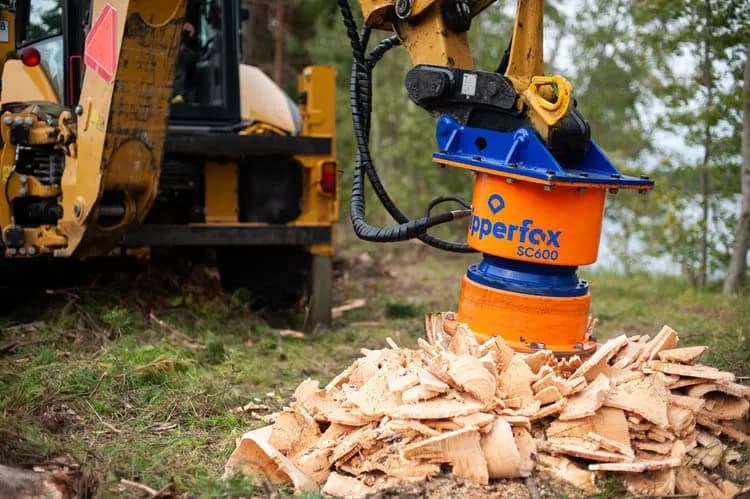
Dipperfox is an Estonian manufacturer whose stump grinders work on a different principle to the wheel grinders most Australian buyers will have seen. Rather than grinding a stump down to a flat surface, the tool works downward into the ground and destroys the stump and root plate in place.
The commercial consequence matters more than the mechanism. There is no spoil heap and no stump to cart away: what is left is coarse chip and reinstated ground. On urban and near-asset sites, where disposal and access are most of the job cost, that changes the cost per stump substantially.
This is a genuine differentiator rather than a badge. It is worth understanding before you compare a Dipperfox quote against a conventional grinder, because the two tools produce different outcomes and the cheaper invoice is not always the cheaper job.
Series by series
Dipperfox 400
Suits 2–6 t mini excavators. Treat this as a range position, then request the current model sheet and complete installed specification for the carrier being quoted.
Dipperfox 600
Mid-range model for standard carriers. Treat this as a range position, then request the current model sheet and complete installed specification for the carrier being quoted.
Dipperfox 850 Pro
Largest model in the range. Treat this as a range position, then request the current model sheet and complete installed specification for the carrier being quoted.
How to shortlist the range
Start with the output the contract purchases: a placed stem, processed residue, controlled section, handled log, maintained profile or prepared ground. Eliminate series that produce the wrong output even when they fit the excavator. Then screen the remaining models against operating weight, lift at working radius, measured auxiliary flow, working pressure, return limit and required circuit functions.
Request a quotation for the complete installed package: attachment, machine-specific bracket, hitch interface, rotator, hoses, couplers, controls, guarding, freight, commissioning, training and initial wear stock. Ask the supplier to state every carrier assumption and qualification. This keeps an apparently inexpensive loose head from being compared with a working system.
Finally, compare support around the series rather than the logo. Identify which wear and failure parts are physically held in Australia, realistic replenishment time, field-service coverage and warranty exclusions. Parts commonality across several Dipperfox attachments is valuable only when the relevant items are actually stocked and the fleet uses them often enough.
What distinguishes Dipperfox
A real differentiator rather than a badge — the mechanism, not just the branding, is different from conventional wheel grinders.
Carrier guidance spans roughly 1.5 to 30 tonnes across the range; confirm the specific model against your machine rather than the range as a whole.
Requires a hammer line plus case drain. Skipping the drain is the fastest way to kill the motor.
Who should keep it on the shortlist
A good fit
- ◆Urban and residential removals where nothing can be left behind and access is tight
- ◆High stump counts where cost per stump, not purchase price, decides the economics
- ◆Sites with no spoil tolerance, including finished landscapes and public reserves
- ◆Contractors pricing stump removal as a recurring service rather than an occasional extra
Look elsewhere when
- ◆Operations that are extracting stumps anyway and need them sized for transport — that is stump cutter work
- ◆Buyers wanting clean biomass feedstock, since the chip carries soil and fines
- ◆Carriers above roughly 30 tonnes, which sit outside the published range
Before removing another manufacturer from the shortlist, ask each supplier to respond to the same work and carrier brief. Compare the exact ordered model, installed mass, functions, hydraulic settings, included fitment, guarding, commissioning and wear stock. A broad series claim or an attractive loose-head price is not equivalent to a documented working package.
Keep the supplier response with the selection record and identify which assumptions still need a demonstration. Use representative material rather than a clean showcase item, record cycle and support requirements, and confirm the finished output is the one the contract accepts. This protects the decision from becoming a badge comparison and gives the crew a clear operating starting point.
Record why the selected Dipperfox series won and the conditions that would change that answer. Keep the carrier configuration, material sample, production assumption, supplier qualification and support promise with the decision. This gives the next buyer a usable starting point when the excavator, work type, support distance or annual hours change, and prevents a successful model on one job from becoming an automatic choice for a materially different one.