
The short answer
The broadest forestry range in the group, spanning ten series across every category in this guide. Use this page to narrow the relevant series, then verify the individual model against measured carrier hydraulics, installed mass, lift capacity and the work’s required output. Range breadth is useful; it is not permission to treat every model as interchangeable.
Where the range sits
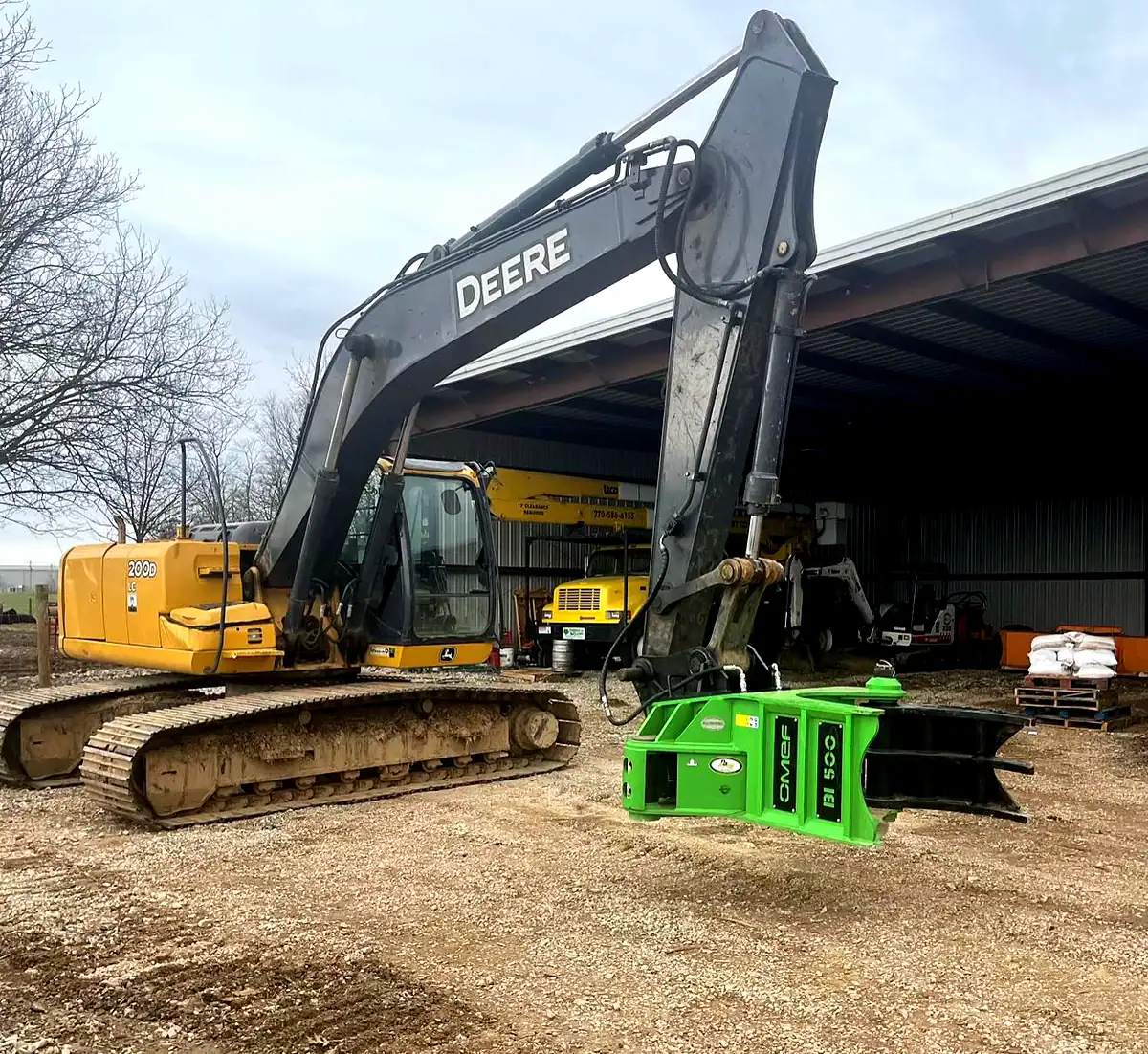
OMEF is an Italian manufacturer of excavator attachments whose forestry range is unusually broad: ten separate series covering six of the eight categories in this guide. In practice that breadth is the brand's defining characteristic. Where most manufacturers specialise in one or two categories, OMEF supplies shears, mulchers, mowers, grapple saws, log grapples, hedge trimmers, pruning bars, forestry pruners, auger drills and soil compactors from a single range.
For a buyer, breadth across a range matters more than it first appears. A mixed fleet drawn from one manufacturer shares mounting conventions, hydraulic specification language and a single parts relationship, which reduces the number of separate supply conversations you have when something wears out. It also means one distributor relationship rather than four.
The counterweight is that no manufacturer is the best in every category it enters. Breadth is a supply and support advantage, not evidence that each individual series leads its category, and the right way to use it is to evaluate each series on its own published specification against your work.
Series by series
BIG INCH tree shears
Six models, 2 to 50 t carriers, trunk widths from 40 mm to 600–700 mm. Treat this as a range position, then request the current model sheet and complete installed specification for the carrier being quoted.
Forestry mulchers
Ten models, approximately 1 to 30 t carriers, single-acting line. Treat this as a range position, then request the current model sheet and complete installed specification for the carrier being quoted.
Hydraulic mower
Double ball-bearing rotor drive for grass and light scrub. Treat this as a range position, then request the current model sheet and complete installed specification for the carrier being quoted.
Grapple saws
Three models, 3 to 30 t carriers, 15 to 160 L/min, dual circuit. Treat this as a range position, then request the current model sheet and complete installed specification for the carrier being quoted.
Log grapples
Mounts across a broader carrier range than the EX series. Treat this as a range position, then request the current model sheet and complete installed specification for the carrier being quoted.
Hydraulic hedge trimmers
Hammer line plus drainage; six or nine cutting blades. Treat this as a range position, then request the current model sheet and complete installed specification for the carrier being quoted.
Pruning cutting bar
Standard hammer line, no drainage line required. Treat this as a range position, then request the current model sheet and complete installed specification for the carrier being quoted.
Forestry pruner
Two double-acting lines. Treat this as a range position, then request the current model sheet and complete installed specification for the carrier being quoted.
Auger drills
Reinforced flighting and replaceable wear parts for continuous duty. Treat this as a range position, then request the current model sheet and complete installed specification for the carrier being quoted.
Soil compactors
Excavator-mounted plate compaction for trench and benched fill. Treat this as a range position, then request the current model sheet and complete installed specification for the carrier being quoted.
How to shortlist the range
Start with the output the contract purchases: a placed stem, processed residue, controlled section, handled log, maintained profile or prepared ground. Eliminate series that produce the wrong output even when they fit the excavator. Then screen the remaining models against operating weight, lift at working radius, measured auxiliary flow, working pressure, return limit and required circuit functions.
Request a quotation for the complete installed package: attachment, machine-specific bracket, hitch interface, rotator, hoses, couplers, controls, guarding, freight, commissioning, training and initial wear stock. Ask the supplier to state every carrier assumption and qualification. This keeps an apparently inexpensive loose head from being compared with a working system.
Finally, compare support around the series rather than the logo. Identify which wear and failure parts are physically held in Australia, realistic replenishment time, field-service coverage and warranty exclusions. Parts commonality across several OMEF attachments is valuable only when the relevant items are actually stocked and the fleet uses them often enough.
What distinguishes OMEF
The widest single-brand coverage in the range, which matters for parts commonality across a mixed fleet.
Published carrier ranges are narrow and specific per model — treat them as the selection constraint, not a suggestion.
The GS grapple saw range is the clearest example of why flow matters: 15 to 50 L/min on the smallest model, up to 160 L/min on the largest.
Who should keep it on the shortlist
A good fit
- ◆Contractors building a multi-attachment fleet who want parts commonality across categories
- ◆Buyers who need a specific model inside a wide carrier range rather than a one-size unit
- ◆Operations running several categories where a single distributor relationship simplifies support
- ◆Mixed vegetation work spanning felling, mulching, pruning and ground preparation
Look elsewhere when
- ◆Buyers who want a single highly specialised tool and do not value range breadth
- ◆Very small carriers below the published minimum for the series in question
- ◆Applications where a competing brand's specific mechanism is the actual requirement, as with in-ground stump grinding
Before removing another manufacturer from the shortlist, ask each supplier to respond to the same work and carrier brief. Compare the exact ordered model, installed mass, functions, hydraulic settings, included fitment, guarding, commissioning and wear stock. A broad series claim or an attractive loose-head price is not equivalent to a documented working package.
Keep the supplier response with the selection record and identify which assumptions still need a demonstration. Use representative material rather than a clean showcase item, record cycle and support requirements, and confirm the finished output is the one the contract accepts. This protects the decision from becoming a badge comparison and gives the crew a clear operating starting point.
Record why the selected OMEF series won and the conditions that would change that answer. Keep the carrier configuration, material sample, production assumption, supplier qualification and support promise with the decision. This gives the next buyer a usable starting point when the excavator, work type, support distance or annual hours change, and prevents a successful model on one job from becoming an automatic choice for a materially different one.