
The short answer
Stump cutters for the extraction-and-process workflow. Use this page to narrow the relevant series, then verify the individual model against measured carrier hydraulics, installed mass, lift capacity and the work’s required output. Range breadth is useful; it is not permission to treat every model as interchangeable.
Where the range sits
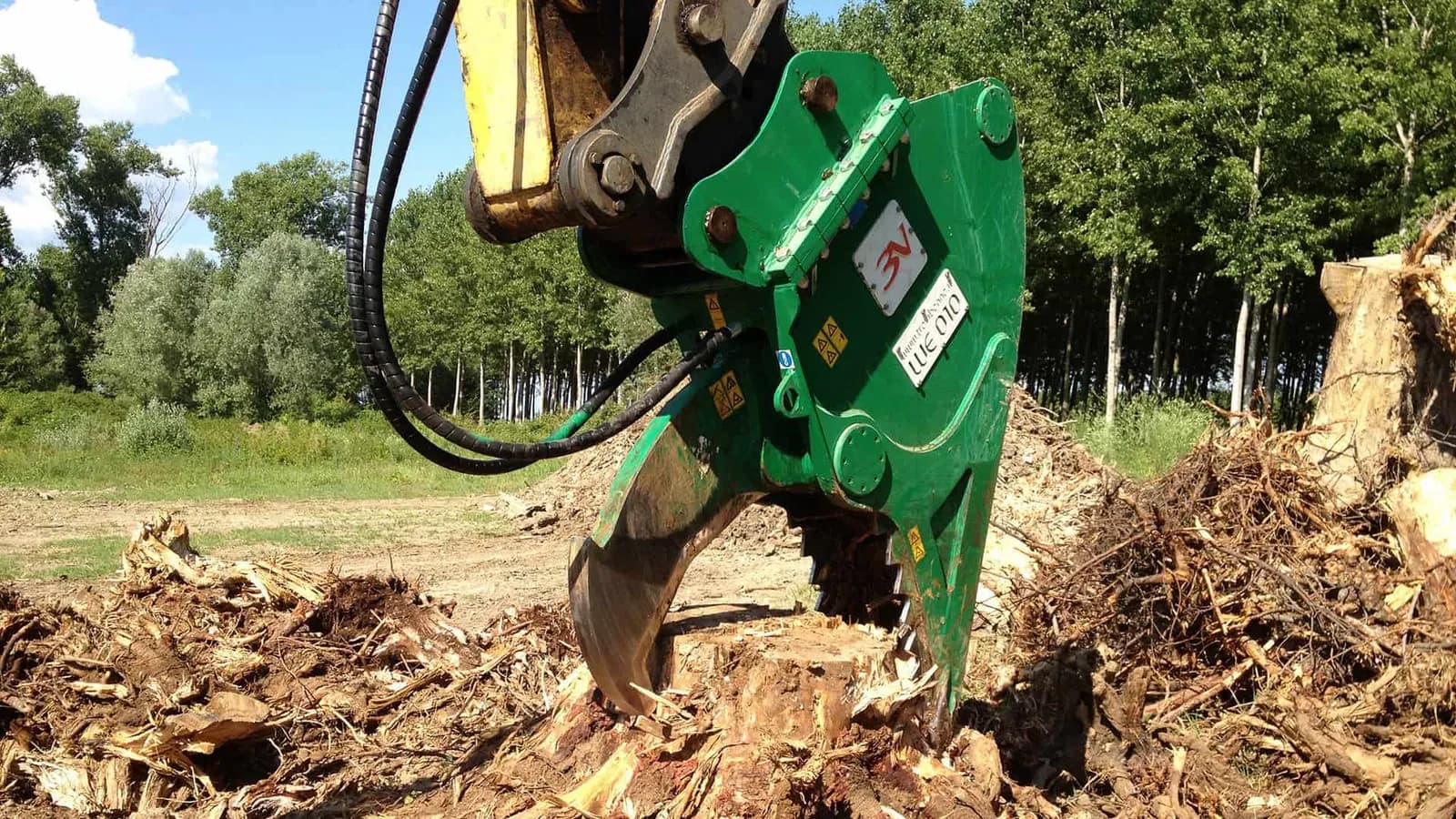
Trevi Benne is an Italian manufacturer of excavator attachments, and within this range it supplies one thing: the WE series stump cutter. That narrowness is worth stating plainly, because the category itself is the most misunderstood in the Australian market.
A stump cutter is not a stump grinder and is not a substitute for one. It works on stumps that have already been extracted, splitting and sizing them on the surface so the material can be transported or chipped. If the stump is still in the ground, a cutter cannot help you.
The buyers it suits are therefore specific: operations already pulling stumps as part of clearing, where the cost being fought is disposal volume rather than stump removal. For them the tool earns its place, and it also slices larger material, which extends its usefulness on a clearing site beyond stumps alone.
Series by series
WE series stump cutters
11.5 to 28 t carriers; splits extracted stumps and larger material. Treat this as a range position, then request the current model sheet and complete installed specification for the carrier being quoted.
How to shortlist the range
Start with the output the contract purchases: a placed stem, processed residue, controlled section, handled log, maintained profile or prepared ground. Eliminate series that produce the wrong output even when they fit the excavator. Then screen the remaining models against operating weight, lift at working radius, measured auxiliary flow, working pressure, return limit and required circuit functions.
Request a quotation for the complete installed package: attachment, machine-specific bracket, hitch interface, rotator, hoses, couplers, controls, guarding, freight, commissioning, training and initial wear stock. Ask the supplier to state every carrier assumption and qualification. This keeps an apparently inexpensive loose head from being compared with a working system.
Finally, compare support around the series rather than the logo. Identify which wear and failure parts are physically held in Australia, realistic replenishment time, field-service coverage and warranty exclusions. Parts commonality across several Trevi Benne attachments is valuable only when the relevant items are actually stocked and the fleet uses them often enough.
What distinguishes Trevi Benne
Not a grinder, and not a substitute for one. It works on stumps that are already out of the ground.
Buy it when disposal volume is the cost you are fighting, not when stump removal in place is your scope.
The narrowest carrier range of any category here, which makes carrier match unusually important.
Who should keep it on the shortlist
A good fit
- ◆Land clearing operations already extracting stumps with an excavator
- ◆Sites where disposal and transport volume is the dominant cost
- ◆Processing extracted stumps into chip-ready material for biomass
- ◆Contractors with 11.5 to 28 tonne carriers running production clearing
Look elsewhere when
- ◆Removing stumps in place — that is stump grinder work and no cutter can do it
- ◆Mini and midi excavators below 11.5 tonnes, which is the entire small end of the market
- ◆Urban and residential removals, where access and no-spoil requirements favour grinding
Before removing another manufacturer from the shortlist, ask each supplier to respond to the same work and carrier brief. Compare the exact ordered model, installed mass, functions, hydraulic settings, included fitment, guarding, commissioning and wear stock. A broad series claim or an attractive loose-head price is not equivalent to a documented working package.
Keep the supplier response with the selection record and identify which assumptions still need a demonstration. Use representative material rather than a clean showcase item, record cycle and support requirements, and confirm the finished output is the one the contract accepts. This protects the decision from becoming a badge comparison and gives the crew a clear operating starting point.
Record why the selected Trevi Benne series won and the conditions that would change that answer. Keep the carrier configuration, material sample, production assumption, supplier qualification and support promise with the decision. This gives the next buyer a usable starting point when the excavator, work type, support distance or annual hours change, and prevents a successful model on one job from becoming an automatic choice for a materially different one.