The short answer
Shear for volume felling in open ground where speed is the goal. Grapple saw where control matters more than throughput, particularly near buildings, roads and services. Both take people out of the fall zone; only one of them cuts cleanly enough for sawlog.
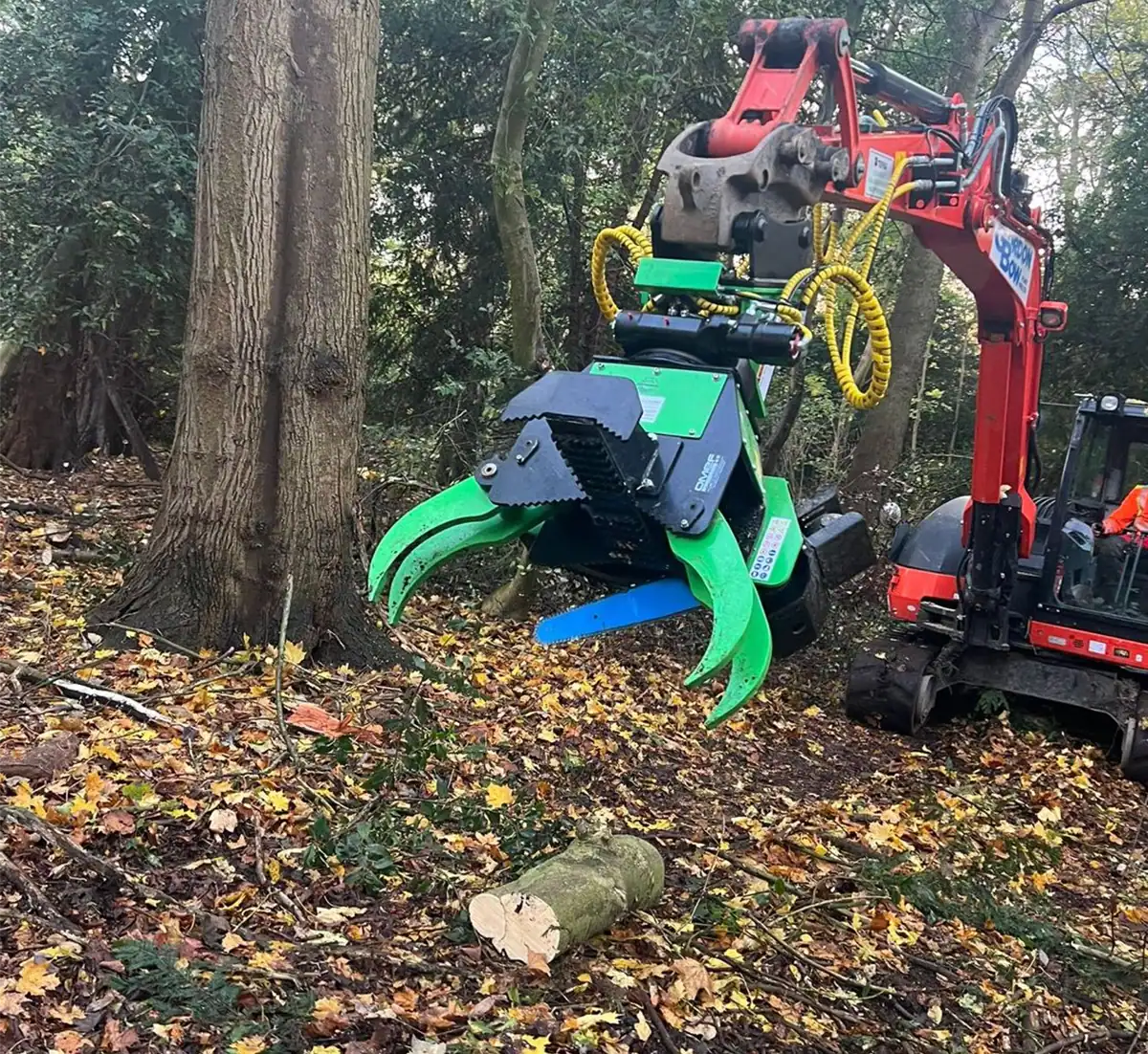
Grapple saw
Holds and saws simultaneously, operated from the ground
Choose it when
- Work is near buildings, roads, powerlines or services
- Sections have to be lowered rather than dropped
- Cut quality matters because the timber is being sold
- You want climbers out of the tree entirely
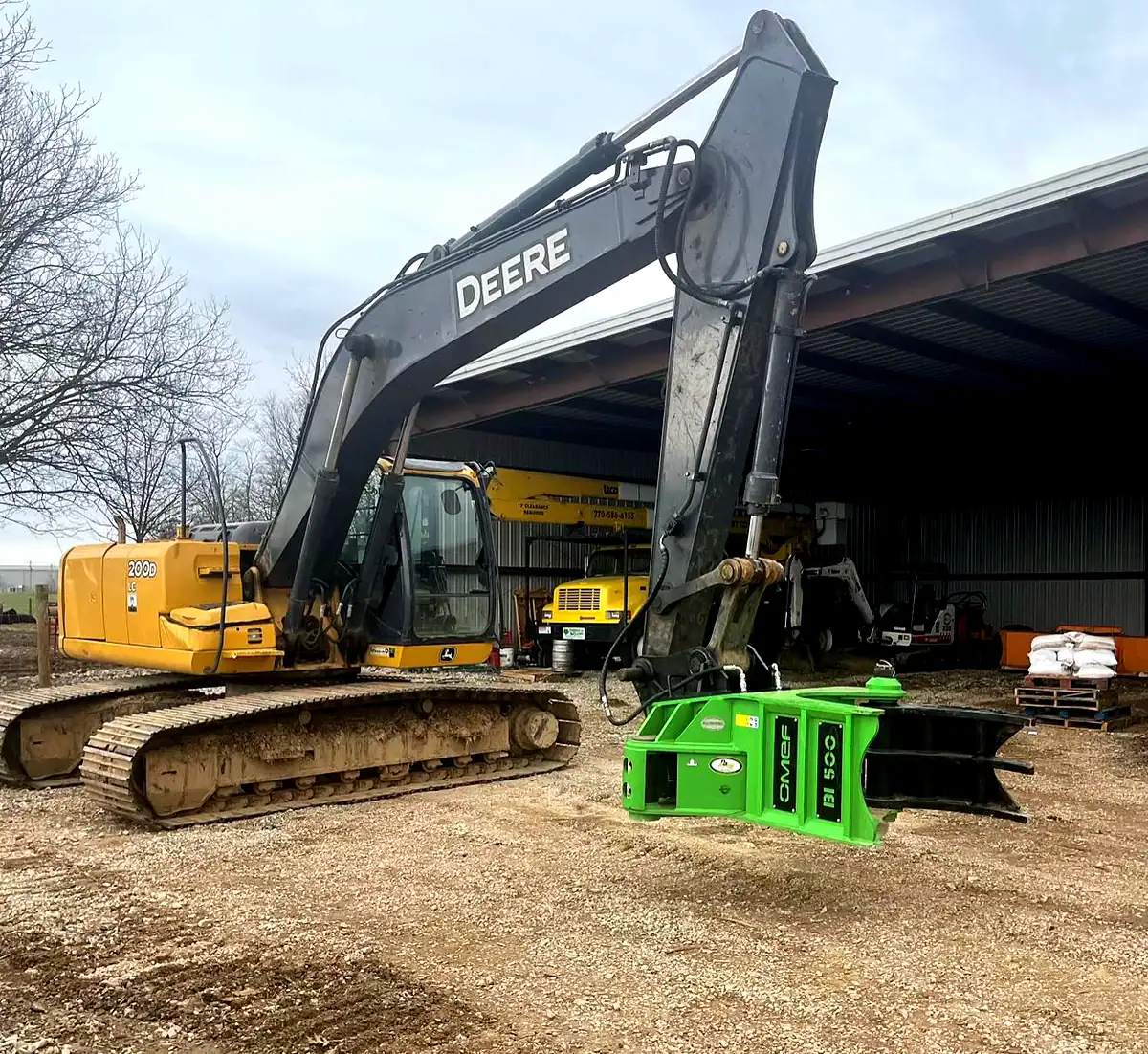
Tree shear
Shears the stem in a single blade stroke and keeps holding it
Choose it when
- Open ground and volume felling, where cycle time is the metric
- Thinning shrubs and small stems at pace
- Timber is going to chip or waste, so a crushed cut does not matter
- You need the widest possible carrier range, up to 50 tonnes
Side by side
| Criterion | Grapple saw | Tree shear |
|---|---|---|
| Cut quality | Clean saw cut, suitable for sawlog | Crushed and split at the cut face |
| Cycle time | Slower — saw has to complete the cut | Faster — one blade stroke |
| Placement control | Full — hold, rotate, lower | Good, but coarser |
| Circuit | Dual circuit: saw line plus grapple and rotation | Double-acting |
| Carrier range | 3–30 t | 2–50 t |
| Consumables | Chains and bars, a weekly conversation | Blades, a periodic rebuild |
| Work near assets | Strong — the reason the category exists | Workable, but less controlled |
| Rotation | 360°, standard across both ranges | Model dependent |
Shaded cell is the stronger side on that criterion
What they cost to own and run
| Cost driver | Grapple saw | Tree shear |
|---|---|---|
| Dominant wear item | Chains and bars, a weekly conversation | Blade rebuild, periodic |
| Circuit cost on the carrier | Higher. A dual circuit with solenoid control is a real workshop job | Lower. Double-acting is commonly already fitted |
| Cycle time | Slower. The saw has to complete the cut | Faster. One blade stroke |
| Value of the output | Higher where timber is sold. A clean saw cut is suitable for sawlog | Lower. The cut face is crushed and split |
| Cost of a mistake near assets | Low. Control is the reason the category exists | Higher. Placement is good but coarser |
No purchase prices appear here, because attachment pricing moves with the exchange rate, the model inside a range, rotation options and the carrier bracket. What moves the number is covered on the attachment costs page, and the utilisation question that decides whether to own either tool is on hire versus buy.
Three situations, three answers
Removals near buildings, roads and services, sections must be lowered rather than dropped.
Grapple saw. This is the work the category exists for, and the safety case and the commercial case point the same way: nobody in the tree, and full control of where each section goes. Confirm your carrier can take a dual circuit before you shortlist models.
Clearing a corridor in open ground, timber going to chip, cycle time is the metric.
Shear. Nothing is at risk, the crushed cut face does not matter because the material is waste, and one blade stroke beats a completed saw cut on throughput. The shear range also reaches further up the carrier scale if you are working with a large machine.
Multi-year clearance panel, mixed corridor with populated and open sections.
Grapple saw as the primary tool, shear on the second machine. The saw handles everything near conductors and structures; the shear takes the open runs where throughput is all that counts. This split is common in utility work for good reason.
When the answer is both
Urban and utility contractors tend to run a grapple saw as the primary tool and a shear on the second machine for the open sections of a corridor, where nothing is at risk and throughput is all that counts.
How buyers get this choice wrong
Buying a grapple saw without confirming the second circuit
This is the most common reason a grapple saw purchase fails on delivery. The tool typically needs a saw line plus a separate grapple and rotation supply, valve-controlled.
Assuming machine weight is enough
The shear range starts at 2 tonnes and the grapple saw range at 3, but flow is the real constraint. A basic breaker circuit on a small machine will not run a large grapple saw regardless of weight.
Underestimating chain and bar consumption
On a grapple saw this is a weekly conversation, not an annual order. Get pricing and lead time in writing before you sign.
Treating a shear as a safety tool near assets
Both keep people out of the fall zone, but only the grapple saw gives you controlled lowering. Near buildings and services that difference is the whole job.
Before you decide
Decision checklist
- Whether the work is near assets or in open ground
- Whether sections must be lowered or can be dropped
- Whether the timber is being sold
- Carrier auxiliary flow and available circuits
- Cost of adding a dual circuit if you do not have one
- Which rotator is specified and what it costs to replace
- Chain, bar and blade pricing and lead time
- Operator experience with the tool you are buying
Questions that follow
01Which is faster overall on a removal?
Shear on the cut, grapple saw on the job. A shear completes each cut faster, but on a removal near assets the cut is a small part of the work. The grapple saw holds, lowers and places each section without a second machine or a ground crew in the zone, and that is usually where the time goes.
02What chain pitch do forestry grapple saws use?
Typically 0.404 inch or 3/4 inch. Pitch determines which chain and bar will fit, so confirm it before you buy consumables, and be wary of any specification quoting a pitch that is not a standard size.
03Can either attachment be used for processing on the ground?
A grapple saw can, and it is one of the reasons the category earns its keep — the same tool that takes the tree down can section it at the landing. A shear can cut material on the ground but the crushed cut face limits what you can do with the timber afterwards.
04Does a grapple saw need two hydraulic circuits?
Typically yes — a saw line plus a separate grapple and rotation supply, valve-controlled. Check this before you buy, because it is the most common reason a grapple saw purchase fails on delivery.
05Is a grapple saw safer than a climber?
It removes the need for anyone to be in the tree, which is the hazard it exists to eliminate. Operator protection on the carrier still matters — ISO 8084 covers the guarding that stops objects entering the cabin.
06Which suits a smaller excavator?
The shear range starts at 2 tonnes and the grapple saw range at 3, but flow is the real constraint. A basic breaker circuit on a small machine will not run a large grapple saw regardless of weight.