Operating principle
Design the attachment as a transportable system: approved resting stand, rated lifting and restraint points, protected hoses and couplers, documented mass and dimensions, and a repeatable changeover sequence. Mobilisation is part of production, not time outside the job. Time the normal crew through loading, connection, testing, disconnection and storage during commissioning. That result belongs in the estimate and reveals where a stand, label, hose park or lifting aid will return its cost. Review the method after any carrier, hitch, rotator, hose or transport change because the safe sequence and dimensions may no longer match.
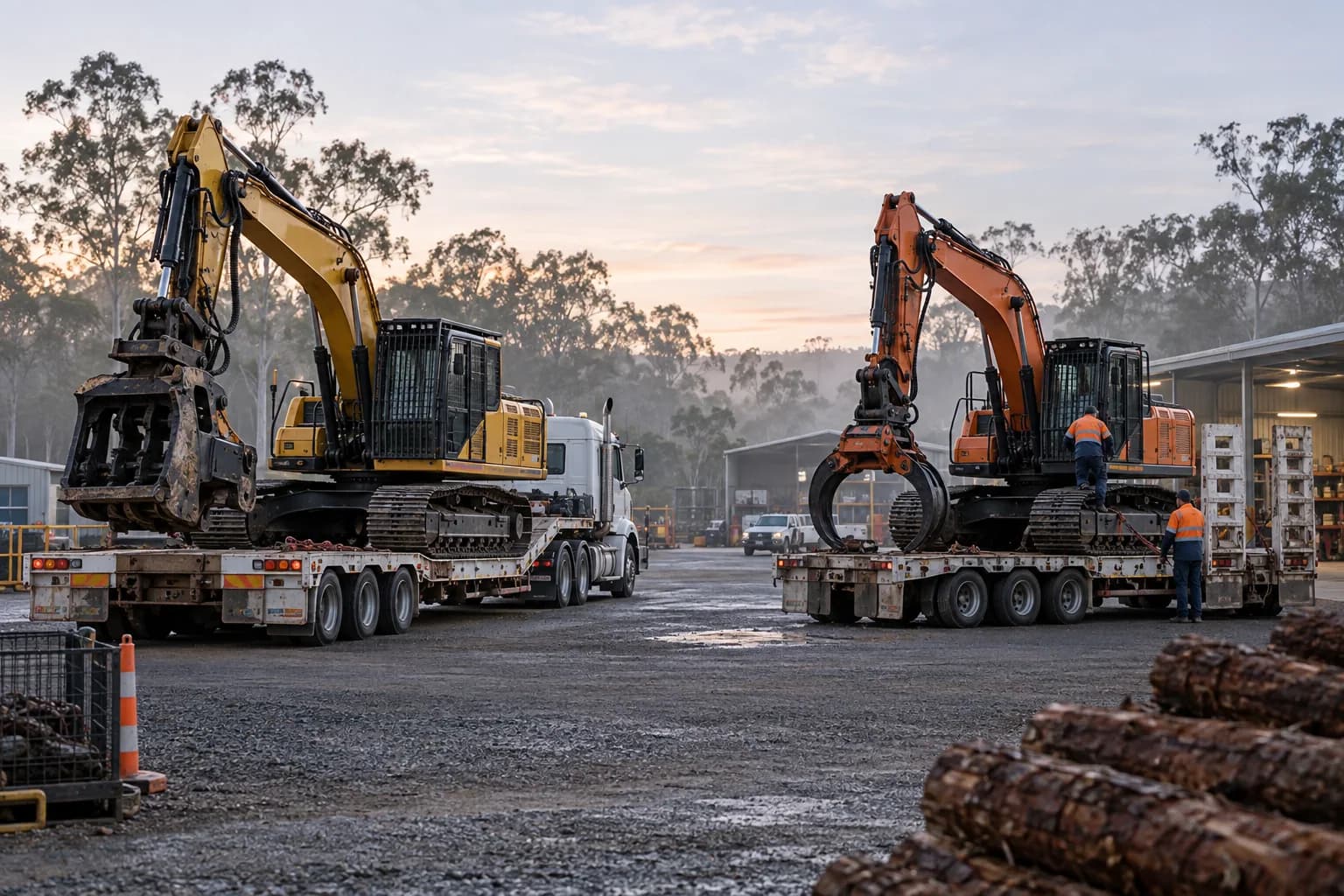
Decide how the attachment travels before purchase
Calculate carrier and attachment mass and dimensions in the actual transport configuration, including hitch, bracket, rotator, guards, counterweight and any transport stand. Confirm whether the head can remain fitted without exceeding float, axle, height, width or restraint limits and whether it blocks safe loading visibility.
If the attachment travels separately, define the lifting device, rated points, orientation, restraints and unloading surface. Do not assume an irregular head can be placed loose on a deck. The stand should support it against rolling, jaw movement or rotor contact and permit connection without a person entering a crush zone.
Protect hydraulics from damage and contamination
Provide parking points for hoses, caps and plugs for every coupler and a method that keeps lines off the ground. Label supply, return, drain and control connections durably. Hose ends damaged during transport create both a leak risk and contamination path into the carrier and attachment circuits.
Depressurise using the manufacturer’s method before disconnection and account for temperature-related trapped pressure. Clean couplers before connection and keep spill containment available. Repeated field changes make contamination control a reliability issue; one dirty connection can cost more than the time saved by rushing the sequence.
Write and time the changeover method
List the safe position, isolation, pressure release, electrical disconnection, hose order, hitch sequence, lifting or stand requirements and final functional test. Perform the method with the normal crew during commissioning and record realistic time. Include the same steps for removing the attachment, not only installing it.
Identify tasks requiring a second person and keep them outside suspended-load and articulation zones. Verify hitch locking visually and functionally. After connection, check hose sweep at low speed and confirm control direction before applying load. A familiar attachment is still a changed machine after every connection.
Store for the next start, not the last finish
Clean enough to inspect, repair known defects, lubricate as specified, protect exposed metal and store the head on a stable stand with hoses capped. Release spring or hydraulic loads only as directed by the manufacturer. Keep controllers, manuals and specialised tools dry, secure and identified with the attachment.
Record location, condition, hours, wear state and outstanding work. Set a pre-deployment date early enough to obtain parts before the next project. Long idle periods can create corrosion, seal, hose and battery issues even when the previous shift ended normally, so storage does not replace the next pre-start inspection.
Measure whether the operating system is working
Choose a small set of records that the crew can collect consistently: productive attachment hours, paid shift hours, completed units, fuel, wear parts, faults, delays and any temperature or pressure observation relevant to the head. Add the material and site condition needed to interpret the result. A number without context can make a hard site look like a machine fault or hide a deteriorating setup behind easier material.
Review the record at the end of the first shift, first week and each meaningful change in work. Compare with commissioning and previous jobs, then assign actions with an owner and date. The purpose is not paperwork volume; it is early evidence. Small changes in play, hose contact, cycle time, heat or consumable use are cheaper to investigate before they become structural repair, motor damage or a missed project window.
Keep this guide with the rest of the operations library and the carrier record so another operator or fitter can repeat the same method.
Related procedures
Ownership costs
Include stands, transport and changeover in the delivered system.
Commissioning tutorial
Prove the changeover and transport method at delivery.
Hire or buy
Account for mobilisation across realistic annual use.