The short answer
Choose a forestry mulcher when stems, regrowth and woody residue must be reduced into a controlled residual layer. Choose a hydraulic mower for grass, weeds and light scrub where fast area coverage and a maintained finish matter more than destroying woody material. A mower is not a lighter, cheaper mulcher; it is a different rotor and duty cycle.
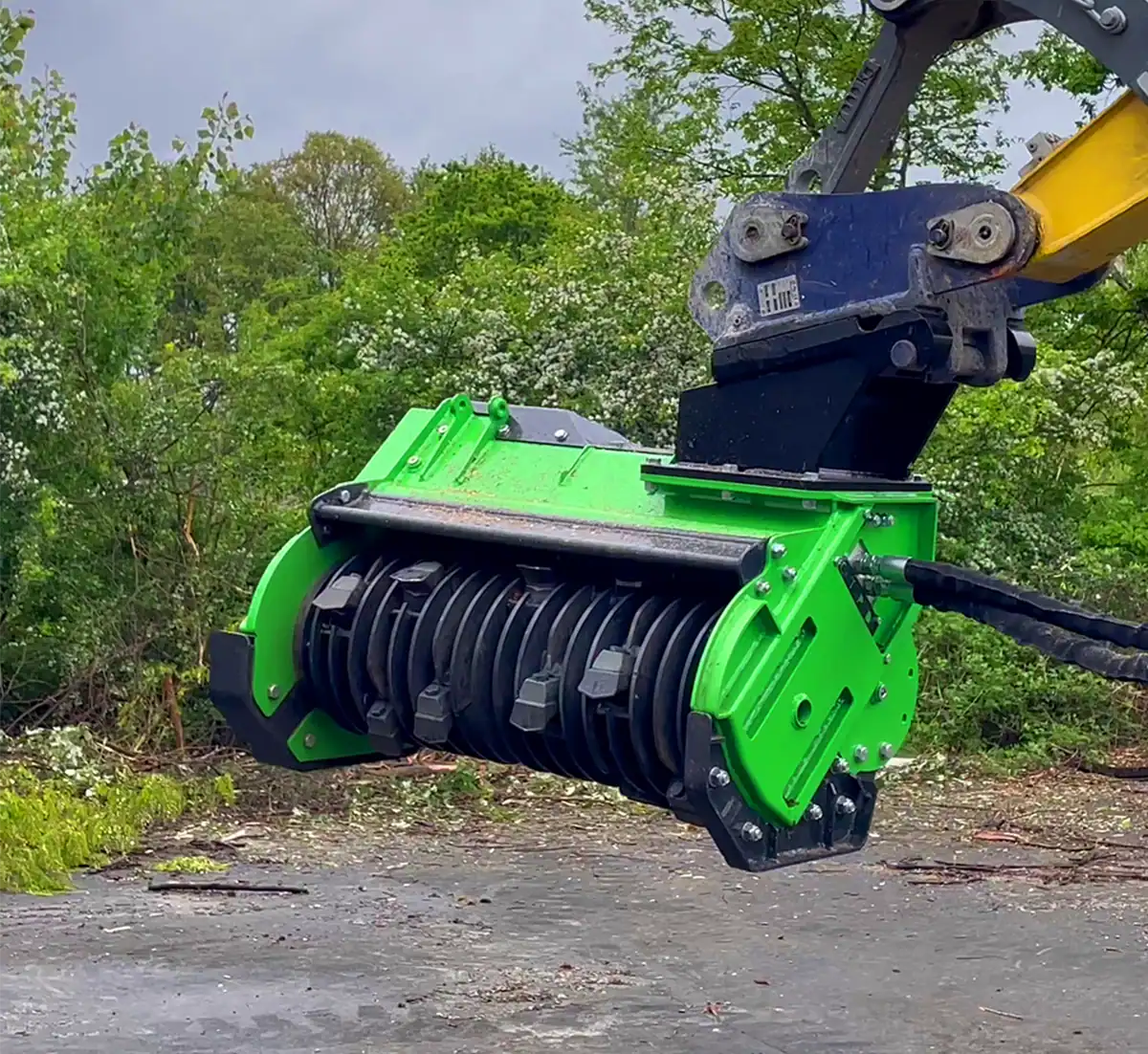
Forestry mulcher
High-energy processing of woody vegetation and residue
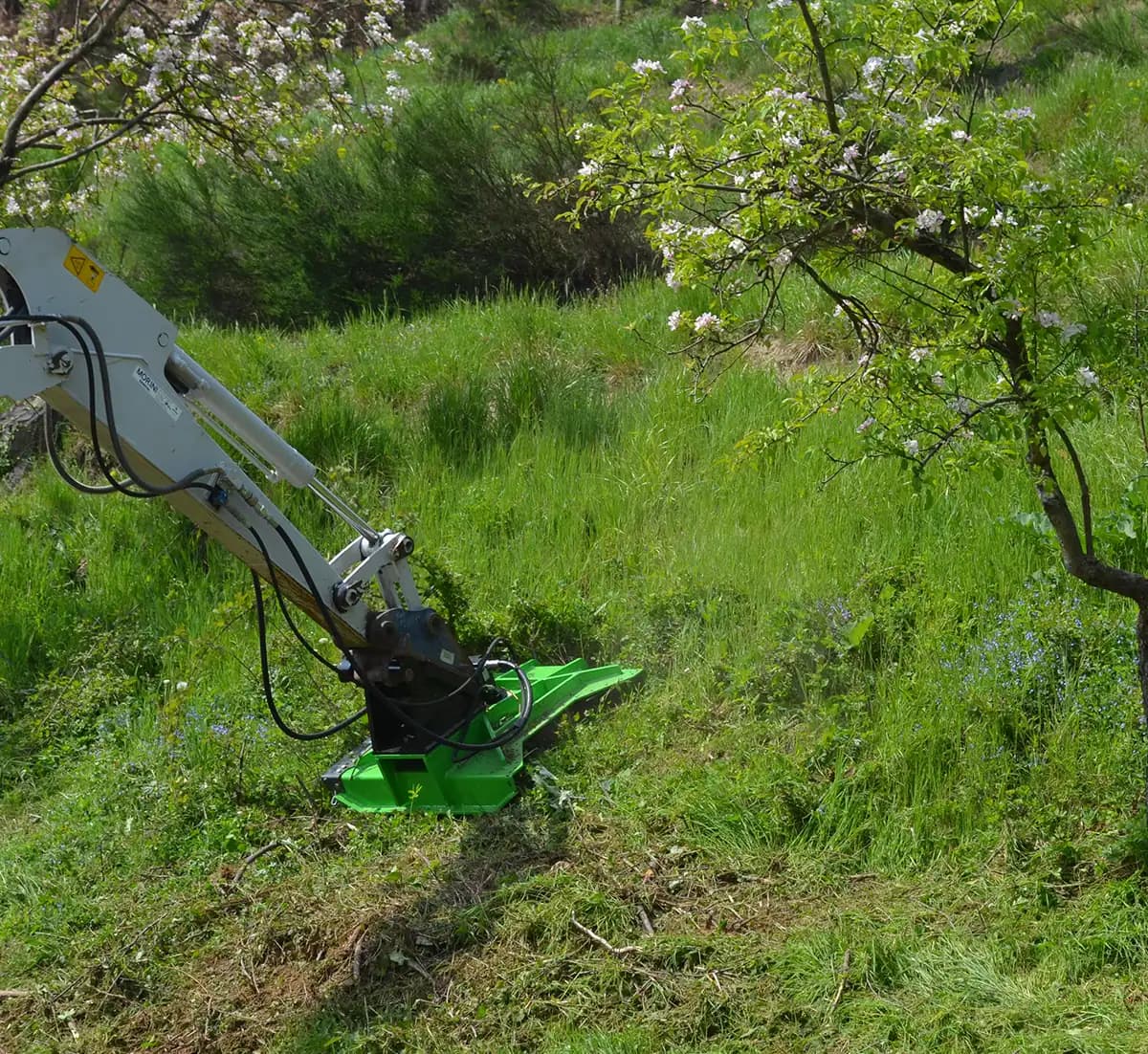
Hydraulic mower
Fast maintenance of grass, weeds and light regrowth
Side by side
| Criterion | Forestry mulcher | Hydraulic mower |
|---|---|---|
| Primary material | Woody regrowth, stems, branches and slash | Grass, weeds and light scrub |
| Finished output | Reduced woody particles and disturbed surface residue | Cut vegetation with a maintained, mown appearance |
| Hydraulic duty | High and sustained; cooling is a selection constraint | Usually lower, but still continuous and carrier-specific |
| Ground contact | Can process near ground; stone and soil accelerate tooth wear | Should follow the surface without being used as a ground grinder |
| Dominant wear | Fixed teeth, holders, rotor and belts or drive | Blades or flails, bearings and drive components |
| Commercial unit | Completed hectares to a specified residual finish | Maintained hectares or corridor distance per visit |
Start with the largest material that must disappear
Walk representative areas and record stem diameter, density, woody fraction, ground hazards and required finish. If the machine must repeatedly attack material that bends away from a mowing rotor or leaves unacceptable stubs, the mower is being asked to become a mulcher. If nearly all material is grass and soft regrowth, a forestry rotor carries weight, fuel and wear the contract may not pay for.
Do not select from the worst isolated stem alone. Map what proportion of the site needs heavy processing and whether those pockets can be cut or handled separately. A mower covering the majority quickly with a second method for occasional timber can outperform a mulcher used slowly across every hectare.
Compare the complete hectare, not rotor speed
Measure from mobilisation and setup to the accepted finish. Include operator inspection, travel, overlap, reversals, tooth or blade service, clearing wrapped material, fuel and any follow-up pass. The faster-looking head can lose once a second machine or manual crew is needed to correct the residual result.
Price wear against the actual contamination. Mulcher teeth in rock, wire or repeated soil contact can dominate the rate. Mower blades also fail when operators use them against woody stems beyond their design. State material exclusions and a variation method so the tender does not turn hidden contamination into an unlimited consumable allowance.
Let repeat frequency decide ownership
Mowing and light scrub maintenance often recur on a predictable cycle, creating annual utilisation and route density. Heavy mulching may arrive as fewer project packages with larger revenue per mobilisation. Model the hours and contribution of each work stream rather than assuming the more capable attachment is the safer purchase.
Where the fleet serves both initial reduction and recurring maintenance, owning both can be rational: the mulcher establishes the corridor or block, and the mower maintains soft regrowth before it returns to woody material. The second tool earns by preventing expensive work from returning, not by replacing the first pass.
Run a matched field trial before committing
Choose a representative work area for each method and define the same accepted endpoint before the clock starts. Record mobilisation, setup, productive work, repositioning, supporting crew and plant, consumables, fuel, delays, material handling, clean-up and inspection. Include every paid hour until the site or work front is released. A trial that stops when the cutting action finishes measures a mechanism rather than a service.
Document material size and density, terrain, access, weather, contamination and operator experience so the result can be reused honestly. Compare completed units per crew shift and total cost per accepted unit, then test the result against low and high production cases. Keep safety controls and exposure changes visible beside the cost: a method may justify itself through fewer people in a drop zone, a smaller exclusion period or less rehandling even when its direct hourly rate is higher.
Use the trial to set operating assumptions, not to declare a permanent winner. Different work packages can reverse the result. Retain a clear boundary for conditions that require the other method and price those exceptions rather than forcing one system across every site.
How this choice goes wrong
Buying on cutting width
Width says little about material capacity, power demand or the finished surface.
Calling every rotor a mulcher
Mowers, slashers and forestry rotors use different cutting systems and tolerate different impacts.
Ignoring cooling
Continuous high-load work can expose a carrier limitation long before lift capacity does.
No finish specification
Two contractors can price different outcomes under the same vague phrase ‘vegetation clearing’.
Decision record
- Woody material percentage
- Maximum repeat stem size
- Required residual finish
- Measured flow at pressure
- Cooling assessment
- Rock and wire contamination
- Annual treatment cycle
- Wear allowance per hectare
Continue the decision
Forestry mulcher guide
Carrier, rotor, wear and production detail.
Fuel-reduction workflow
Match the tool to measurable treatment outcomes.
Cost per hectare
Compare output and wear in the unit the client buys.
More comparisons