The short answer
Use a grapple saw where the carrier can establish a stable working envelope and controlled sections can be cut, held and placed from the ground. Use climbers and cranes where canopy access, reach, rigging geometry, tree condition or site constraints sit outside that envelope. The methods overlap, but neither replaces the other across every tree.
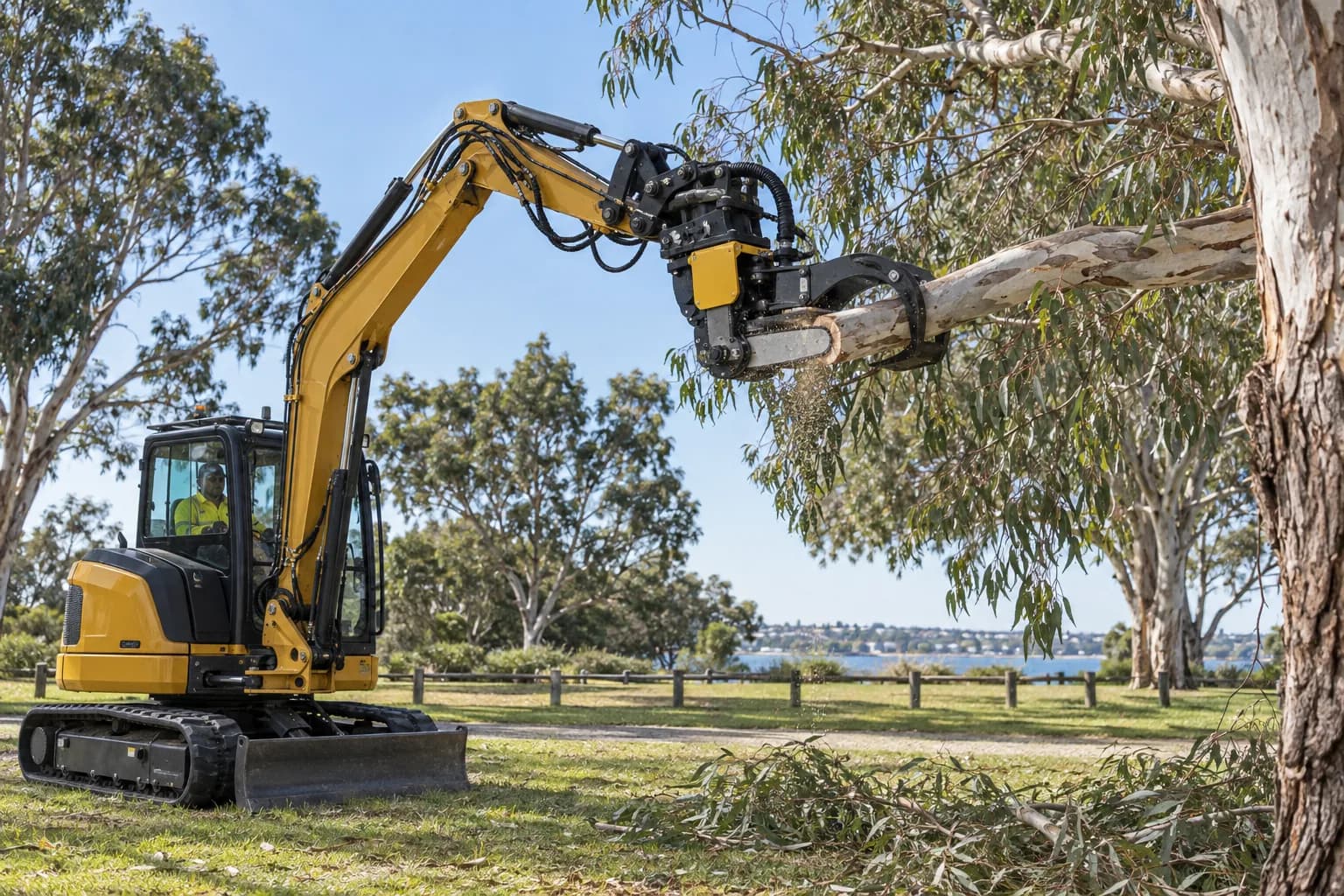
Excavator grapple saw
Ground-based grip, cut and placement from a defined carrier position
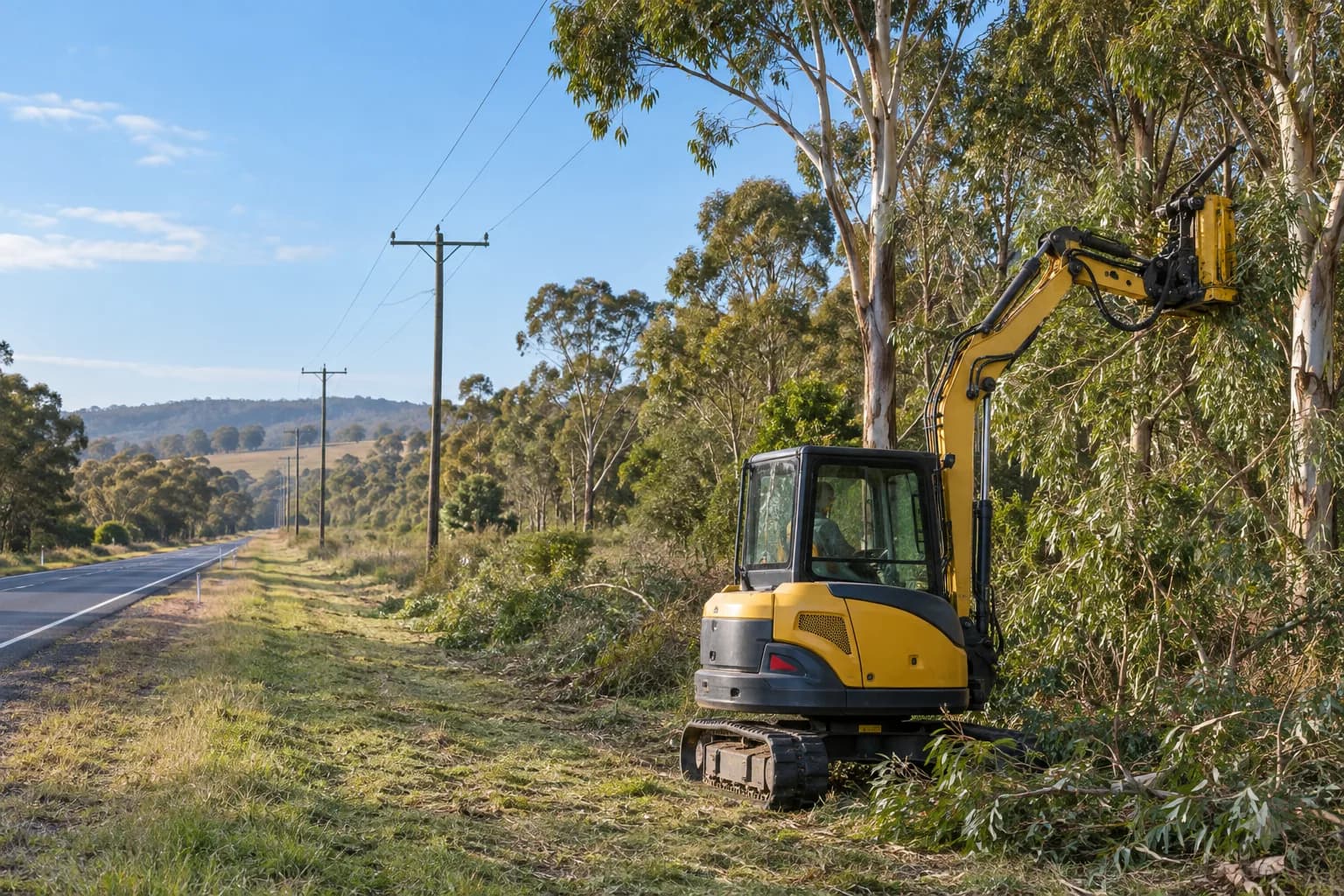
Climber and crane method
Flexible canopy access and rigging where a carrier cannot reach or stand
Side by side
| Criterion | Excavator grapple saw | Climber and crane method |
|---|---|---|
| Access requirement | Stable carrier position and usable approach | Crane setup or climbing access with engineered rigging |
| Working envelope | Bounded by excavator reach and lift at radius | Bounded by crane chart, rigging and climber access |
| People beneath work | Can materially reduce exposure when the full method is mechanised | Requires disciplined rigging, communication and exclusion controls |
| Irregular canopy | Limited by grip geometry and view | More adaptable section selection and rigging |
| Material placement | Direct placement within excavator envelope | Lift path can cross obstacles but needs landing coordination |
| Best production measure | Completed trees or reopened zones per crew shift | Completed trees including setup, rigging and site release |
Draw the working envelope before choosing the method
Map carrier standing positions, slope, ground bearing, reach, obstacles, retained assets and the landing zone. Use the excavator lift chart with attachment, hitch, rotator and retained section included. The useful grapple-saw envelope ends where the machine cannot safely hold and place the cut piece, not where the boom can touch it.
For the conventional method, map crane setup, outrigger loads, lift path, rigging points, climber access and exclusion area. A site that excludes the excavator may accept a crane, and the reverse is also true. Compare feasible methods before production assumptions.
Redesign the crew around mechanisation
A grapple saw creates value when it removes people from the cut and drop zone and combines grip, cut and placement. If ground workers still guide every section beneath the head, the method has preserved exposure while increasing cycle speed. Define communication, exclusion, visibility, emergency lowering and disabled-head recovery.
The downstream crew must keep pace. Sections need landing, sorting, chipping, loading or further cutting. Measure the completed tree and reopened work area, because a rapid saw cycle followed by a blocked landing is not a faster removal system.
Keep hybrid methods available
Some projects suit a grapple saw for lower and accessible sections, with a climber or crane handling the canopy beyond reach or pieces that cannot be gripped safely. Hybrid planning can reduce time aloft and crane picks without pretending the ground machine covers the complete tree.
Price each phase and its mobilisation explicitly. The grapple saw should not be justified by removing a crane that the remaining canopy still requires, and the crane should not be scheduled for work the excavator can complete more efficiently before arrival. Sequence, not brand preference, decides the saving.
Run a matched field trial before committing
Choose a representative work area for each method and define the same accepted endpoint before the clock starts. Record mobilisation, setup, productive work, repositioning, supporting crew and plant, consumables, fuel, delays, material handling, clean-up and inspection. Include every paid hour until the site or work front is released. A trial that stops when the cutting action finishes measures a mechanism rather than a service.
Document material size and density, terrain, access, weather, contamination and operator experience so the result can be reused honestly. Compare completed units per crew shift and total cost per accepted unit, then test the result against low and high production cases. Keep safety controls and exposure changes visible beside the cost: a method may justify itself through fewer people in a drop zone, a smaller exclusion period or less rehandling even when its direct hourly rate is higher.
Use the trial to set operating assumptions, not to declare a permanent winner. Different work packages can reverse the result. Retain a clear boundary for conditions that require the other method and price those exceptions rather than forcing one system across every site.
How this choice goes wrong
Using maximum reach as capacity
Lift and control normally become limiting before the boom reaches its geometric maximum.
Ignoring retained-section mass
The section is part of the lifted load and can exceed the head mass.
Leaving debris out of the method
Cutting productivity is meaningless when the landing or chipper controls the crew.
Claiming complete replacement
Canopy geometry, condition and access preserve work that needs climbers or cranes.
Decision record
- Carrier standing position
- Lift at working radius
- Section mass estimate
- Grip and control functions
- Visibility and cameras
- Exclusion and communication
- Landing and debris flow
- Hybrid work boundary
Continue the decision
Grapple saw guide
Carrier circuits, reach and section control.
Arborist industry profile
Connect the method to crew and service lines.
Utility vegetation workflow
Plan access windows and debris handling.
More comparisons