The short answer
Choose a tree shear where the carrier can grip, cut and place repeat stems safely and downstream handling can absorb the output. Keep chainsaw felling where access, selectivity, terrain, retained vegetation or unusual stem form defeats the machine envelope. Judge both methods at the point where timber is safely landed and the work area is released.
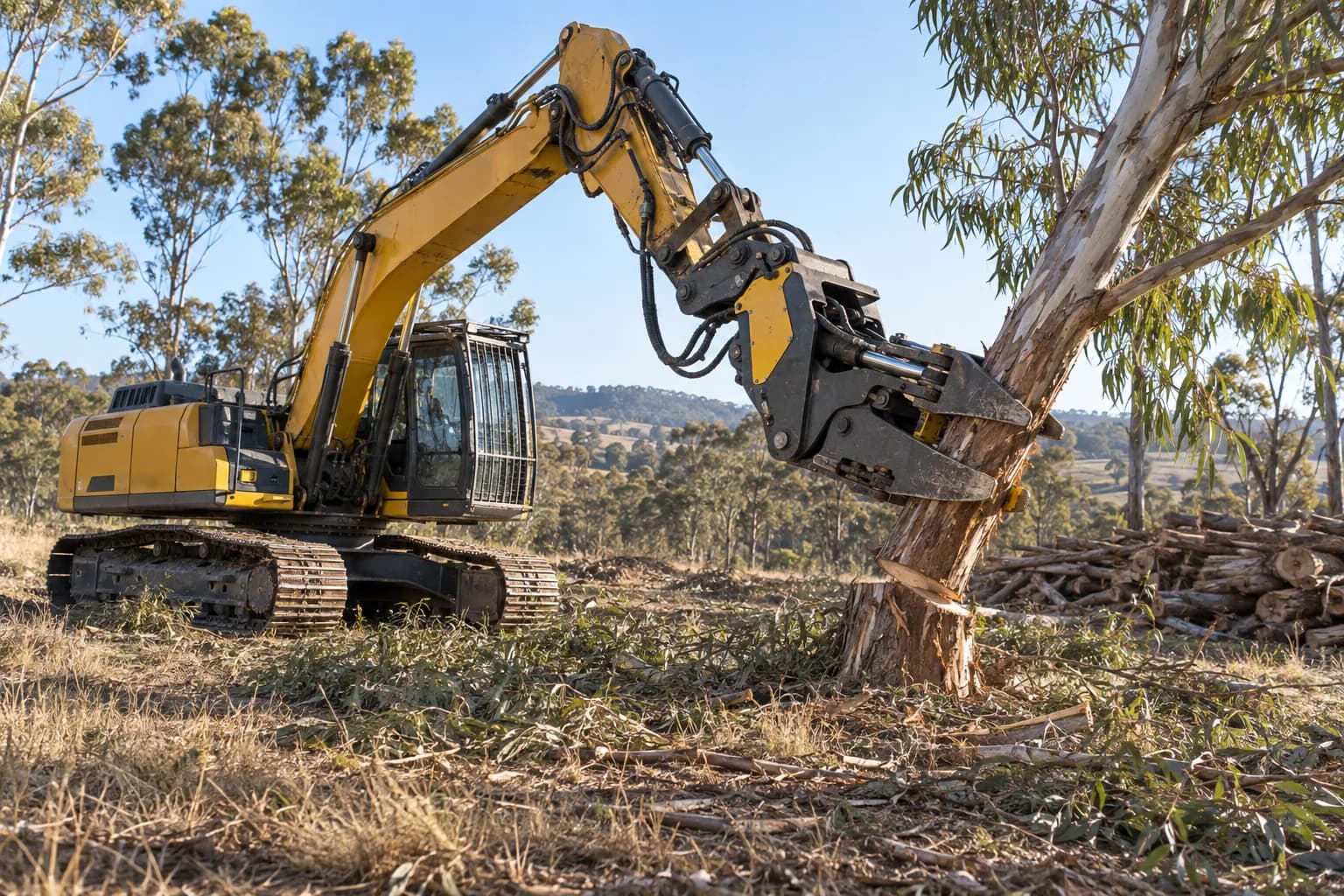
Excavator tree shear
Mechanised grip, cut and controlled placement from the cab
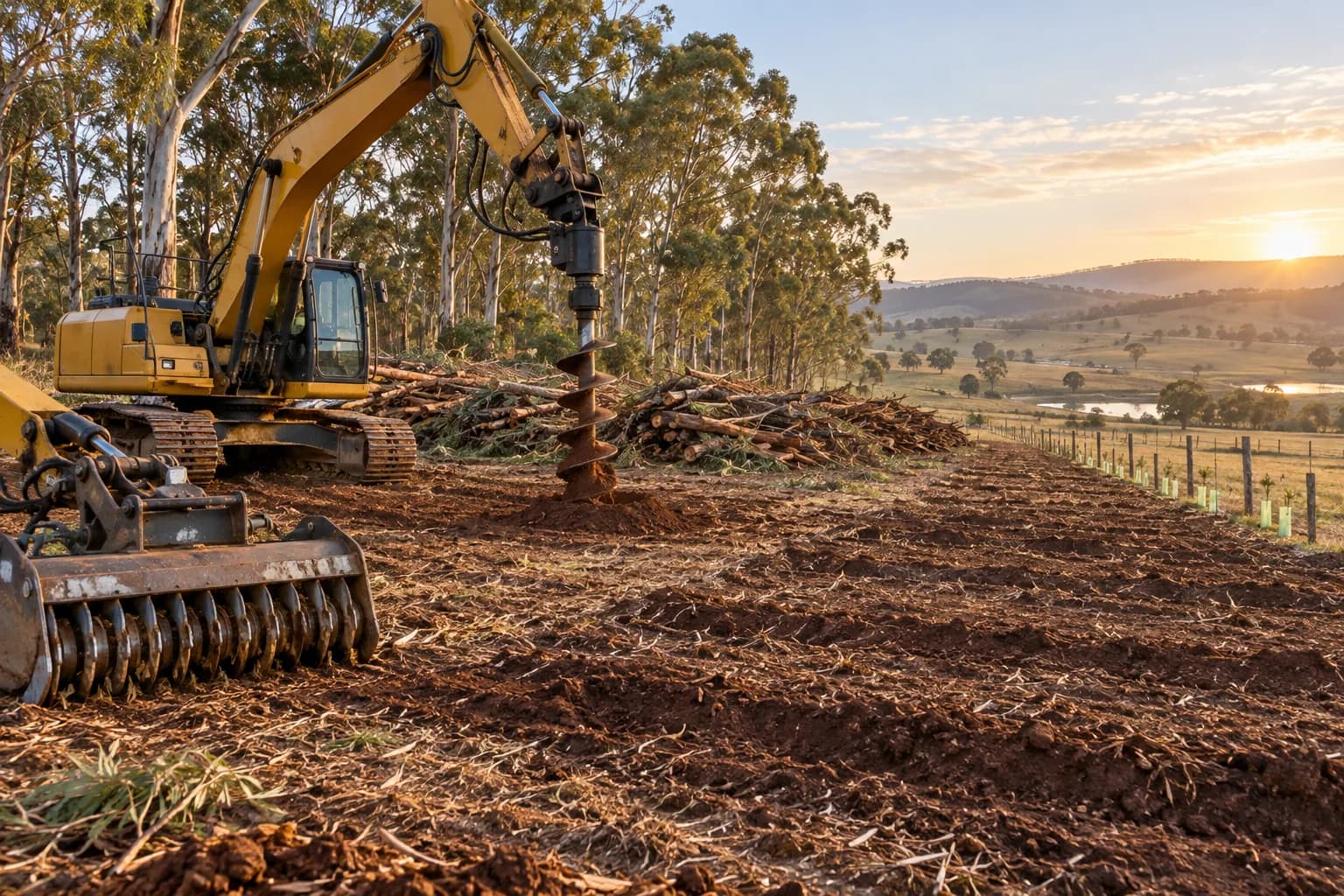
Chainsaw felling crew
Flexible manual felling across constrained and selective sites
Side by side
| Criterion | Excavator tree shear | Chainsaw felling crew |
|---|---|---|
| Best material | Repeat stems within jaw and carrier capacity | Variable form, access and selective individual work |
| Placement | Stem remains mechanically controlled through the cut | Controlled through felling technique, wedges, winching or rigging |
| Terrain and access | Needs stable carrier access and room to handle the stem | Can reach ground unavailable to an excavator, subject to safe work planning |
| Crew exposure | Moves cutting into a protected cab when the exclusion zone is maintained | Places workers at the tree and requires manual controls |
| Timber handling | Can place or stack directly within reach | Often needs a separate machine after felling |
| Commercial measure | Completed and placed stems per carrier shift | Completed and cleared stems per crew shift |
Separate repeat production from exceptional trees
Sample diameter, species, lean, branching, buttress, defects, spacing, slope and retained assets. A shear performs best where many stems fit a repeatable grip-and-cut method. One exceptional tree outside that envelope should not dictate the tool for the whole block, but it needs a separate safe method.
Chainsaw crews remain valuable for selective access and trees whose geometry cannot be gripped or placed by the carrier. Plan the boundary in advance. An operator discovering it at the tree creates delay and pressure to use the attachment beyond the intended range.
Design the material flow after the cut
A shear can place stems into a stack, landing or processing line, preserving timber value and removing a second handling cycle. That advantage disappears if the landing fills or transport cannot keep pace. Map each stem from standing position to its final accepted location.
Manual felling may need a grab or skidder to separate, extract and stack material. Include that machine and crew in the comparison. Conversely, a shear carrier may spend valuable time walking between dispersed stems that a small crew reaches efficiently. Compare the whole shift and complete output.
Price utilisation, not theoretical replacement
Tree shears carry attachment capital, bracket, guarding, transport and carrier opportunity cost. Chainsaw crews carry labour, competency, supervision, consumables and exposure controls. Use annual repeatable stem volume to determine whether ownership is justified, then keep a subcontract or manual method for exceptions.
Record completed stems, placed tonnes or released area along with carrier and crew hours. Separate waiting, travel, handling and attachment changeover. Those records show whether the shear has removed a work step, reduced exposure or merely moved labour to a different point in the operation.
Run a matched field trial before committing
Choose a representative work area for each method and define the same accepted endpoint before the clock starts. Record mobilisation, setup, productive work, repositioning, supporting crew and plant, consumables, fuel, delays, material handling, clean-up and inspection. Include every paid hour until the site or work front is released. A trial that stops when the cutting action finishes measures a mechanism rather than a service.
Document material size and density, terrain, access, weather, contamination and operator experience so the result can be reused honestly. Compare completed units per crew shift and total cost per accepted unit, then test the result against low and high production cases. Keep safety controls and exposure changes visible beside the cost: a method may justify itself through fewer people in a drop zone, a smaller exclusion period or less rehandling even when its direct hourly rate is higher.
Use the trial to set operating assumptions, not to declare a permanent winner. Different work packages can reverse the result. Retain a clear boundary for conditions that require the other method and price those exceptions rather than forcing one system across every site.
How this choice goes wrong
Comparing cut time
The useful endpoint is a safely placed stem and released work area, not separation at the stump.
Using published maximum diameter
Dense, buttressed or poorly gripped hardwood should be derated from favourable test material.
No exception method
A block always contains stems or positions outside the repeat mechanised envelope.
Ignoring carrier opportunity cost
The excavator may earn more on other project work when stem volume is intermittent.
Decision record
- Stem distribution and species
- Slope and carrier access
- Lift with retained stem
- Placement and landing
- Downstream handling capacity
- Exception method
- Annual repeat volume
- Completed-stem cost
Continue the decision
Tree shear guide
Jaw types, carrier match and honest limits.
Land-clearing workflow
Place felling inside the complete material sequence.
Civil industry profile
Connect clearing output to released work fronts.
More comparisons